When you buy through links on our articles, Future and its syndication partners may earn a commission.

Astronomers using the James Webb Space Telescope (JWST) say they have found the strongest evidence yet for an atmosphere around a rocky world outside our solar system.
The findings challenge the prevailing wisdom that relatively small planets orbiting extremely close to their stars cannot sustain atmospheres.
The ultra-hot super-Earth, TOI-561 b, is the innermost of at least three planets circling a 10-billion-year-old star located about 280 light-years from Earth. The planet orbits at just one-fortieth the distance between Mercury and the sun, completing a full orbit in under 11 hours.
That extreme proximity places it in a class of ultra-short-period super-Earths that are heated to temperatures high enough to melt rock. Under such conditions, scientists generally expect planets to lose any atmosphere due to intense stellar radiation, leaving behind bare, airless rock. But observations from NASA's TESS space telescope have shown TOI-561 b has an unusually low density for a purely rocky world, suggesting that another explanation may be needed.
"It must have formed in a very different chemical environment from planets in our own solar system," Johanna Teske, a staff scientist at the Carnegie Earth and Planets Lab in Washington D.C. who led the new paper, said in a statement.
To test whether the planet has an atmosphere, the team used the JWST's NIRSpec instrument to measure the temperature of TOI-561 b's dayside. In May 2024, JWST observed the planet–star system continuously for more than 37 hours, capturing four full orbits. Scientists focused on moments when the planet passed behind its star, events known as "secondary eclipses" when the planet's own light briefly disappeared. By measuring the tiny drop in the system's total brightness during each eclipse, the team could isolate the planet's infrared glow and directly determine its dayside temperature.
If TOI-561 b had no atmosphere, its dayside should reach roughly 4,900 degrees Fahrenheit (2,700 degrees Celsius). Instead, the JWST measured a temperature much cooler, around 3,100 degrees Fahrenheit (1,700 degrees Celsius). To understand why, the researchers tested a range of possible surfaces and atmospheric types to see which could reproduce the signal observed by JWST.
"We really need a thick volatile-rich atmosphere to explain all the observations," study co-author Anjali Piette of the University of Birmingham said in the statement. "Strong winds would cool the dayside by transporting heat over to the nightside."
The team suggests the planet may maintain a balance between its molten surface and its atmosphere, allowing gases to cycle between them and potentially replenish the atmosphere over time.
The team suggests the planet may maintain a balance between its molten surface and its atmosphere, allowing gases to cycle between them and potentially replenishing its atmosphere.
"While gases are coming out of the planet to feed the atmosphere, the magma ocean is sucking them back into the interior," study co-author Tim Lichtenberg of the University of Groningen in the Netherlands said in the statement. "It's really like a wet lava ball."
The results open the door to probe the interiors and geological activity of such extremely hot rocky planets by studying their atmospheres, the researchers note.
The findings were published on Dec. 11 in the The Astrophysical Journal Letters.
LATEST POSTS
- 1
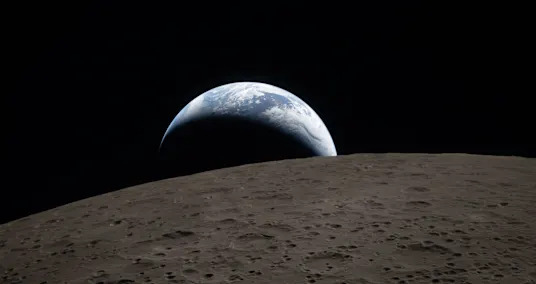
 Artemis II astronauts channel Apollo 8 with a striking Earthset photo
 - 2Nigeria’s return to Windsor castle signals new era in UK economic partnership
- 3Focus on Yourself: Wellbeing and Taking care of oneself Practices
- 4Vacuum Cleaners That Are Not difficult To Use For Home
- 5Iran fires one of largest barrages in weeks ahead of Passover




- IVE 2026 'Show What I Am' Tour: How to get tickets, prices, dates and more
- German state railway loss widens, passengers warned of trouble ahead
- Israel halts defense sales to France, citing 'hostile attitude,' sources tell 'Post'
- New Gaza militia declares war on Hamas: 'Your dirty shoes are more honorable'
- Germany records first wolf bite on human since repopulation
- Rick Steves Recommends This German Town's Castle Hotel With Rhine River Views
- She just became the first wheelchair user to travel to space
- Find the Specialty of Public Speaking: Drawing in and Convincing Crowds with Certainty
- An ex-FBI agent analyzes what we learned from Savannah Guthrie's 'Today' show interview amid the search for her mother Nancy